
Marginalia...
... for Knots in the String.
(More particularly, ‘notes made in the margins’).
ASAP:
‘As slow as possible
As soft as possible
As soulful as possible.
As sustainable as possible.
As sincere as possible.
As steady as possible.
Allow space and pause…’ (Unknown)
Wouldn’t it be the most perfect thing to live each day in such a way? I suppose in our own ways we all try, but life does tend to intervene. Sometimes, I think the only way would be to live like an eremite. But we do the best we can, don’t we?
I look at my own life. My way of living slow is to live outside the city. Soft is with love for those I hold dearest. Soulful is when I walk in nature – a spiritual thing. Sustainably? By trying never to have more than I need and to make do. Sincere? Always – by never lying and always trying to listen, to support. Steady? Hmm – that’s a work in progress. I’m not a regularly steady person, by my own admission. Finally, to allow space and pause? I try. Always.
It pays every now and then to examine one’s life without condemnation or disappointment, to accept that none of us is perfect. Good intentions are surely all that matter.
Other things:
The name for this post came from this link: But I suppose it could have just as easily have been called eclectica or somesuch. In respect of the link, birds are the melody of our lives. I have two feeders which are supposed to support the little birds that live in the garden – wrens, finches, wagtails, even sparrows. But unfortunately, the parrots (blue-winged, I think) are rather pushy and tend to take over and binge on all the nosh for themselves.
Then there are the maudlin bush ravens that look like crows and have an horrendous call. They fly in… murders? Congresses? Perhaps mobs, or more kindly, flocks. I’d prefer it if they didn’t come calling at all. Ugly things in their heavy black accoutrements! It’s not a step too far to see them as harbingers.
The magpies however, speak to me with their wonderful mouth-full-of-marbles chatter and joy and when I see them studying me, I know they’re using memory. Is she the one who gave us that little piece of meat? Yes! See there’s the little dog. Oh good… We meet a small gang not far outside our gate on our walk and lately they’ve been flying in and removing corbies from the lawns. Go for it, chaps!
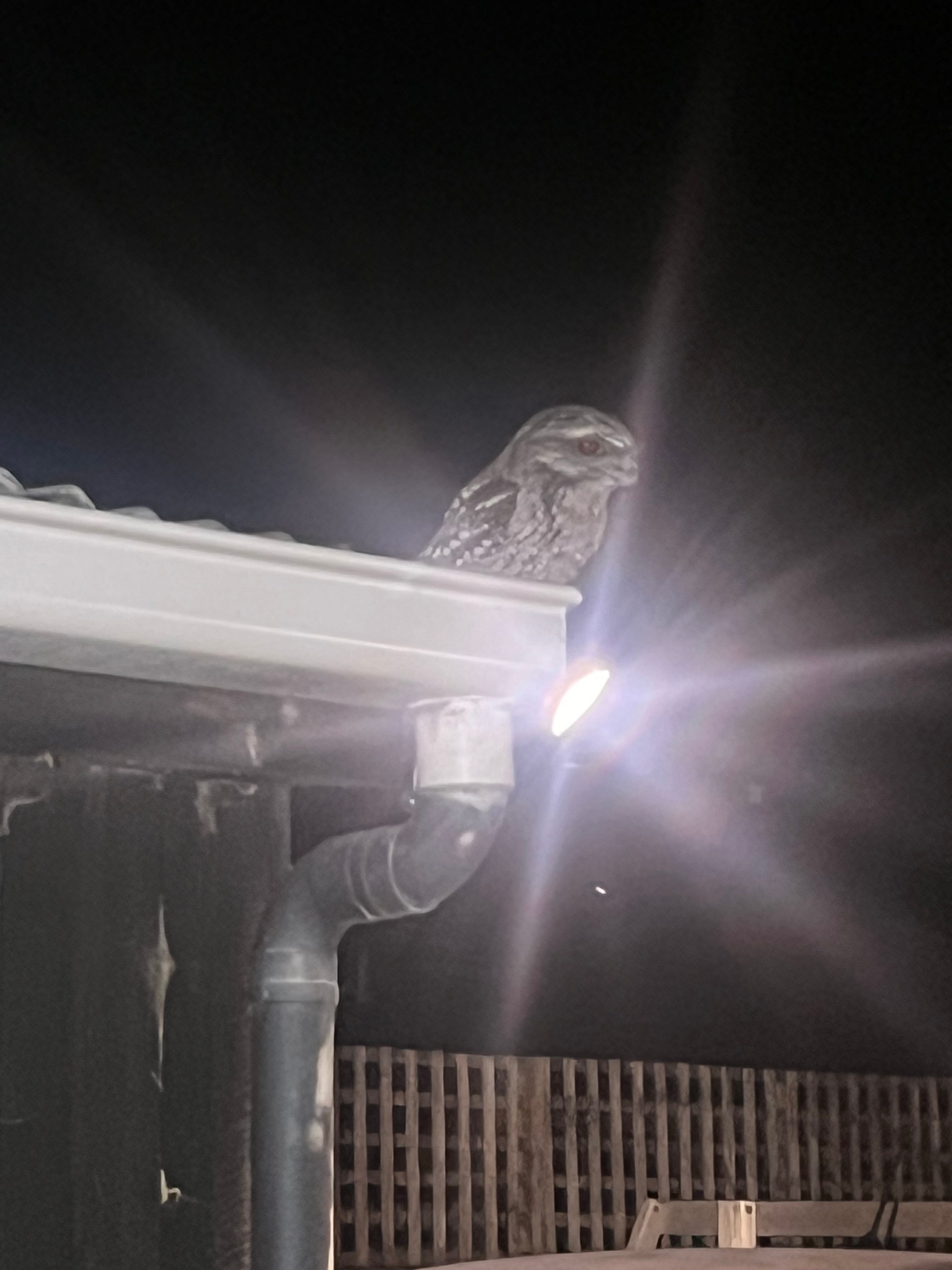
Marvellously, a tawny frogmouth has moved in. He’s a nocturnal feeder that perches on the roof of the boathouse near the motion light and feasts on moths and other insects attracted by the brightness. A striking bird and he/she may stay as long as he/she likes. Then there’s the sea eagles, the wedgetails, all the magnificent shorebirds and the native woodpigeon called a bronzewing whose melodious cooing I truly love. I never mind been woken by that bird, but some others? Not so much. Do you know that some bird or other (I was too sleepy to wonder which) woke me at 4.30 the other morning? One expects that in summer, but not winter! The seasons, and the natural world are so confused at the moment…
In respect of the link above though, I have the greatest admiration for the poetic way in which Robert Macfarlane writes about nature. Landmarks is a favourite, but the beautifully illustrated Book of Birds is now on my ‘wish list’.


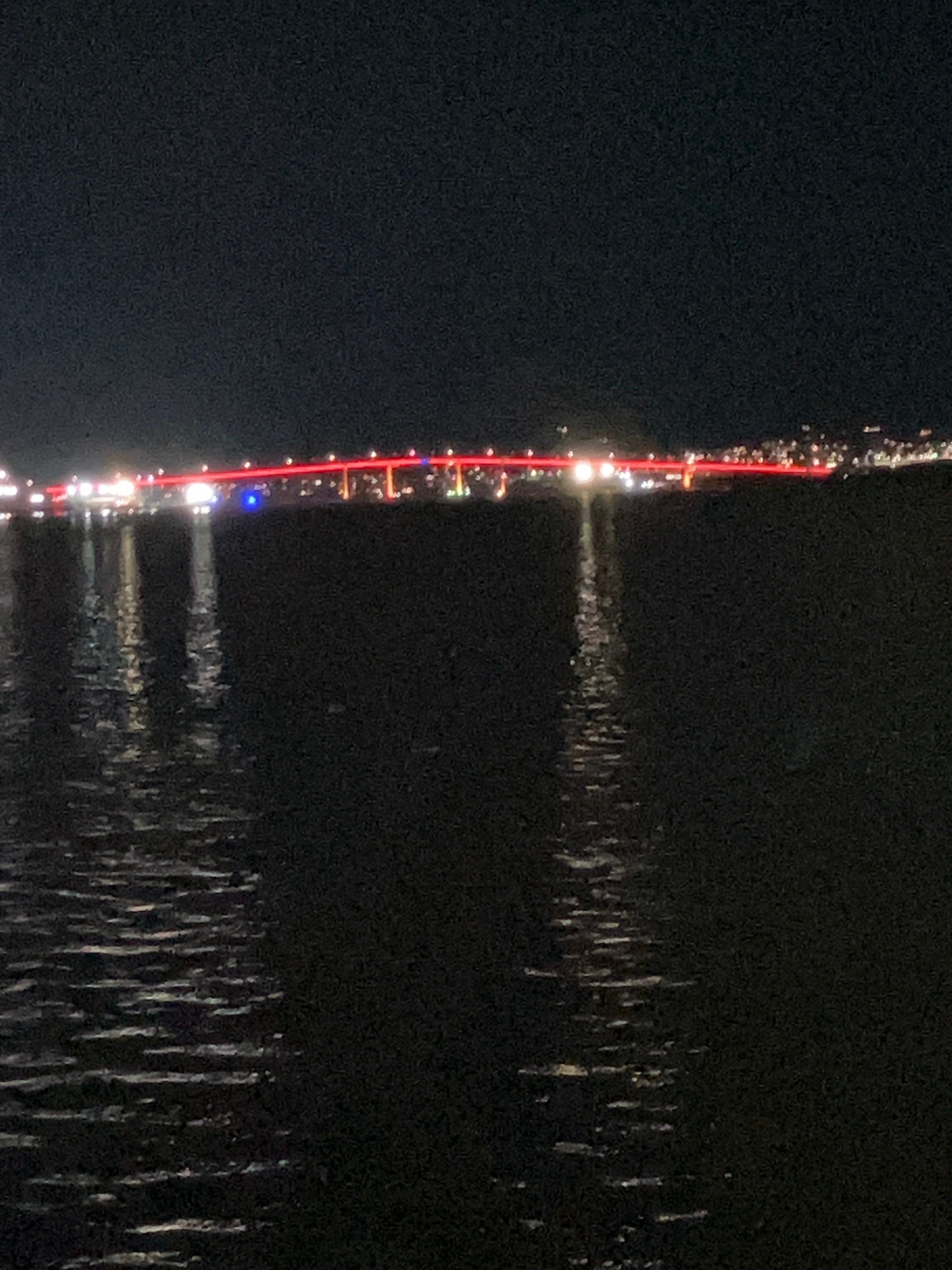
Another little note in the margins was the observation of raindrops like crystals hanging from the Oyster Bay pineneedles. And toadstools that have sprung magically with rain. The Tasman Bridge lit red for Dark Mofo (see below).
Marginalia are extraordinary. I first learned about them in medieval history at university many years ago when studying for my degree. The current hist.fict WIP, The Oblate, is about a 12th century scribe, a young, frail and talented monk who has come upon straitened circumstances. He would have used marginalia quite frequently. Often, the tiny illustrations were filled with humour, a tongue-in-cheek way of poking tongues at their very circumscribed world. There are knight rabbits armed with lances, fornicating snails, snails ridden by mice armed with swords, and there are penises. Many and varied penises. One wonders just what herbs and flowers the monk-scribes were eating and what was chasing through their minds in the echoing stone chambers filled with the stench of tallow candles. Perhaps it was that their thoughts were being slowly poisoned by the pigments they were using, for we know now how lethal some colours like vermilion, lead white, orpiment and others were.


Brother Bruno watched as Brother Andreas dipped the quill into the ink. The priest compressed his lips tight, as if such an action would help his writing and Bruno smiled. He had a similar habit – biting down on his bottom lip. He had grooves which proved it.
The Greek monk had proved remarkably adept. Father Paisios was content that Brother Andreas work with Bruno so long as the chores were done for the day, and thus the two monks made a habit of taking time in the afternoon to sit – teacher and pupil. Andreas learned to read swiftly and thus his knowledge of letters grew apace. Within two days of placing a quill in the monk’s hands, Bruno had him copying the words from the Luke Gospel. He made errors of course, and when he did or when he dropped a small inkblot here and there, Bruno taught him to paint simplistic marginalia which helped build Brother Andreas’ confidence and stretched a happy grin across his face.
Ah, perhaps we must wait for Brother Bruno’s story until Phoebe’s Prime is finished.
I received an email the other day from a book promoter who told me that for a price, my historical fiction books could be bestsellers (oh yes?) but that my Instagram and Substack accounts were wrongly focused. All about my island life when the accounts would be much better centred on my novels and my life as a writer. I thought how wrongly she had read me. If she had scanned any line of any novel of mine, right through all fifteen books in the three genres of fantasy, hist.fict and contemporary, she might have realised that my life and experiences here at the bottom of the world infuse my novels from beginning to end. So it is with any writer. We don’t write in complete vacuums. We think, we breathe, we feel, we do – and it vacillates through our writing like a pearly mist.
And anyway, I confess to hating the idea of pimping my trade and books but I love writing about this island and life’s experiences within it. For example, I came across a perfumier the other day, a woman in Hobart who is creating highly individual and very beautiful scents made from Tasmanian flora. Then there’s the winter festival Dark Mofo in Hobart, which hangs on all things bold and shocking in the cultural world. People arrive from all over the world for it and Hobart is flooded with red light. All I can say is that whilst it would be wonderful to sell more books, why wouldn’t I want to talk about the way this island flies on the wings of enigmatic ambience?


Finally, a rather precious little note in the margins. I was in the city for the night so that I could go to ballet class and I was dusting the lounge. I held a little puzzle box which belongs to my husband and heard rattling inside. How had I never heard it before? I worked out the way the lid turned at an angle and then slid sideways and within lay a perfect pound note, a half sovereign dating from 1861 and a sovereign dating from 1910. Tucked with the money was a tiny handwritten note to my then one year old husband from his grandmother. We have managed to value the find at about $A5000. Did Granny realise that her gift would accumulate in value and was that the purpose for her grandson? Also, I want to know where Granny learned to write so beautifully?
She was an astonishing woman – a widow from an early age, raising two sons and running a farm on her own – pigs, sheep and cattle. She was well-thought of in the local Whittlesea Shire community and my husband remembers her with love, having a number of stories about her for the family. I was so glad the little box had rattled because we would never have known what it contained. We just thought it was a wooden ornament carved to look like a box that never opened. Why did it rattle right then at that particular moment? Is it just serendipity?
Anyway my friends, here is the song for the week – wouldn’t we all love to be free as birds?
I've developed an affection for all furry critters, realizing that they're just trying to survive and live peacefully (like us humans). Knowing that birds are the ancestors of dinosaurs is really fascinating!
That little time capsule/puzzle box from hubby's grandma is such a treasure! It makes me think about leaving something like that for my own grandkids, to open after I'm gone. Hmm...what to put inside? Perhaps the US penny, which is no longer being minted. Or some other item that's been relegated to the dustbin of history? I'll have to give this some further thought...
Love learning more about your various birds, Prue. The Tawny Frogmouth is a delight - what a photo! - and similar to the North American Whippoorwill and Chuck-Wills-Widow. I've never seen one in real life. The treasure unearthed from that tiny puzzle box is a story for future generations. Thank goodness you're a writer!